
Pumpkin carving safety and keeping your jack-o'-lantern fresh longer: a dated plan for October 31, 2026
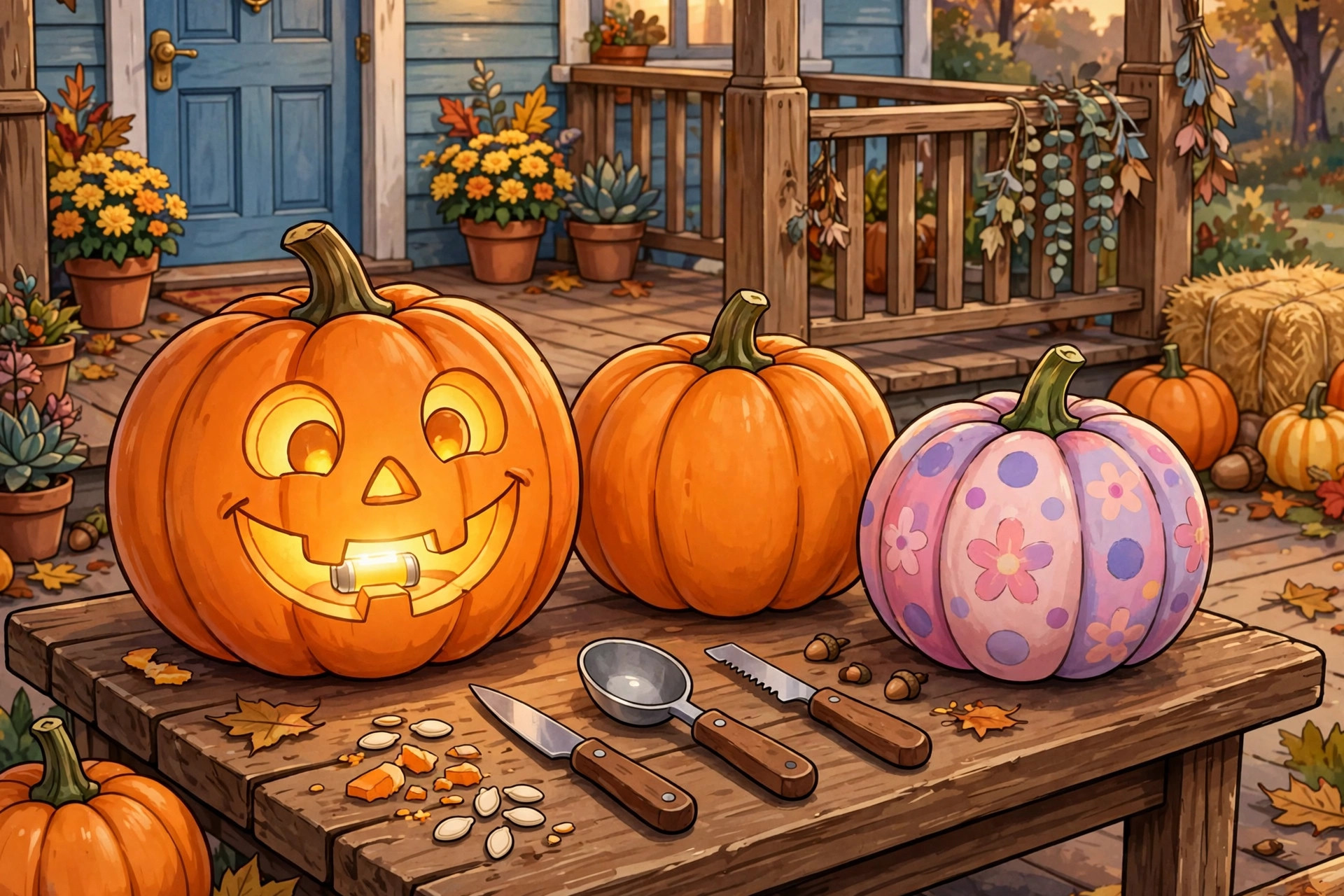
Halloween falls on Saturday, October 31, 2026 — eighteen days from October 13. That gap is exactly where jack-o'-lanterns go wrong. Carve this weekend and the face will likely be soft before the big night; carve at the kitchen table on October 30 with a bread knife and wet hands, and the risk changes from rot to injury. This guide puts the two problems together in one dated plan: when to carve, who should hold the tool, and which preservation claims hold up when the sources are compared side by side.
Safety note: this is general information, not medical or safety advice for a specific household. Bleach is a household chemical — follow the product label, keep it away from children and pets, ventilate, and never mix it with other cleaners. If a carving cut causes numbness, tingling, trouble moving a finger, or bleeding that does not slow with pressure, seek medical care promptly.
Why carving is the risky part
The U.S. Consumer Product Safety Commission estimates an annual average of about 3,200 Halloween-related injuries treated in U.S. emergency departments over a recent three-year period. The breakdown is the useful part: about 55 per cent were related to pumpkin carving, about 25 per cent were falls — putting up or taking down decorations, tripping on costumes, or walking while trick-or-treating — and about 20 per cent were other lacerations, ingestions, and costume, pumpkin, or decoration injuries, including allergic reactions. In other words, the pumpkin is not a side risk. It is the main one.
Two details change how a household should plan. First, about 54 per cent of the injured were adults and 46 per cent were under 18 — this is not only a children-and-knives problem; the adult doing the carving is the most likely person to be hurt. Second, an orthopaedic hand surgeon quoted in the American Academy of Orthopaedic Surgeons' October 8, 2026 release warns that a carving cut can damage tendons, nerves, or blood vessels under the skin, and that numbness, tingling, or difficulty moving a finger after a cut should be evaluated promptly. A small-looking cut is not automatically a small injury.
The official guidance is consistent across sources: leave the carving to adults, work in a clean, dry, well-lit area, and use tools designed for pumpkin carving rather than general kitchen knives, which can stick in thick pumpkin flesh and then release suddenly. Children are not left out of the project — the CPSC's own framing gives child helpers the scooping spoon and the marker to trace the design. Drawing and scooping are real jobs, and they keep small hands away from the blade entirely.
Pick a pumpkin that can wait
Freshness starts before any knife appears. A Virginia Cooperative Extension horticulture expert advises choosing a pumpkin with deep, solid colour and a hard shell that a fingernail cannot easily puncture. That test matters more than size or a perfect shape: a soft spot is decay that has already started, and carving will only speed it up. Pumpkins can withstand a light frost, but a hard freeze damages them, so a pumpkin bought now for an October 31 display in Canada should wait somewhere cool and dry rather than on a sunny porch through warm afternoons and freezing nights.
The lifespan numbers explain why waiting works. An uncarved pumpkin can last at least 10 to 12 weeks. Once carved, the range collapses: one expert summary puts carved pumpkins at as little as three days and typically decomposing within a week, while an orchard manager's estimate for an untreated carved pumpkin is five to ten days. Those ranges differ because temperature, cleanliness, and how thoroughly the inside was scraped all matter — but every source agrees on the direction. Uncarved is measured in months. Carved is measured in days.
The carve-by decision: work backwards from October 31
Use the shortest honest lifespan, not the most hopeful one, and the calendar makes the decision for you:
| Your plan | Carve / make by | Why |
|---|---|---|
| Carved, no preservation steps | October 28–30 | Inside the 3-to-5-day end of the carved range, so the face is still firm on October 31 |
| Carved, with cleaning and edge-sealing below | October 26–28 | Preservation can help, but no source promises it doubles the life — leave a buffer |
| Carved for a party the weekend before | Within 8–10 days of that party, at most | NC State Extension's outer limit for carving ahead of an event |
| Painted or sticker-decorated (no carving) | Any time from now | The pumpkin stays uncarved, so the 10-to-12-week clock applies — and children can do the whole job |
| Display pumpkin, uncarved | Buy now, display now | No cut surfaces, no rot clock; carve it late only if the plan changes |
The decision framework is simple: the earlier the display needs to start, the less carving it should involve. A porch that must look finished by October 20 should be built on uncarved and painted pumpkins, with one carved centrepiece added in the final three days. A single-night display can be carved on October 29 or 30 and needs no preservation heroics at all.
A safer carving procedure, step by step
- Wash first. Wash the pumpkin in cool, soapy water and dry it completely. A clean, dry surface is also a safer surface — moisture on hands, tools, or the pumpkin is what makes a blade slip.
- Set the workspace. Choose a clean, dry, well-lit area and a stable surface. Keep the carving tools — designed for pumpkins, not borrowed from the knife block — in that area only.
- Assign the jobs. Adults carve. Children trace the design with a marker and scoop the inside with a spoon. Nobody under carving age holds a carving tool, even “just for one cut.”
- Open from the bottom or back (optional). Extension guidance suggests cutting the opening from the bottom or back instead of the top; it can make placing a battery light easier and leaves the stem and top intact.
- Scoop thoroughly and dry. Remove all of the insides — Utah State University Extension links leftover material to mould — sterilize the carving tools, and dry the inside with a clean towel after scooping.
- Cut in small, controlled strokes, away from the body. Keep the free hand out of the line of the cut, reposition the pumpkin instead of reaching across the blade, and stop if hands or tools get wet or slippery.
- Preserve and seal (see the comparison below). If using a bleach method, follow the product label, work with ventilation, and keep children and pets away until the pumpkin is fully dry. If sealing edges with petroleum jelly, commit to a battery light — the jelly is flammable.
- Light it without a flame. Use a battery-operated light or glow stick. Every safety source in the packet prefers this to an open-flame candle, and heat also speeds decay inside the pumpkin.
Keeping it fresh: methods compared, honestly
Preservation advice online sounds like one recipe. It is not. The sources in the research packet disagree on bleach strength and contact time, so the table shows each method as its source actually reported it instead of blending them into a single confident formula. Any bleach use should follow the label on the product in hand, which outranks every article — including this one.
| Method (as reported) | Source | Trade-off to know |
|---|---|---|
| Wash, then rinse in a 10% bleach solution and dry; after carving, submerge in a 10% bleach solution for at least 8 hours | Virginia Cooperative Extension, via Virginia Tech | The strongest and longest method reported; a long soak needs a container, ventilation, and keeping kids and pets away |
| Spray cut areas with 1 tablespoon of bleach per quart of water | Orchard manager, via a Kentucky TV station | Much weaker dilution and no soak — the two bleach methods are not interchangeable, which is why the label matters |
| Rub petroleum jelly (or olive oil, in the orchard account) on carved areas | Virginia Tech; orchard manager | Seals in moisture and slows drying — but petroleum jelly is flammable, so a real candle is off the table |
| Keep cool and shaded, ideally about 50–60°F (about 10–15°C) | Utah and NC State extension guidance, via Better Living | Free and chemical-free; a warm, sunny porch undoes it — bring the pumpkin into a cool spot on warm afternoons |
| Do nothing; carve late | All sources agree on timing | An untreated carved pumpkin lasts roughly 3–10 days depending on conditions — enough, if the carving date is honest |
One disposal note closes the loop: a spent pumpkin can go in the compost. Feeding a pumpkin to livestock or wildlife is only appropriate if no toxic decorative materials were used on it — another reason to think before applying chemical sprays to a pumpkin that will end up outdoors where animals can reach it.
FAQ
It is October 13. Can a pumpkin carved today last until October 31? On the sourced ranges, no — even the most generous untreated estimate is five to ten days, and typical carved life is three days to a week. Paint a pumpkin today; carve one in the last few days.
Which bleach recipe is the right one? The sources conflict, so there is no single verified recipe to pass on. Follow the directions and safety warnings on the bleach product itself, or skip bleach and rely on the two methods every source agrees on: carve late and keep the pumpkin cool and shaded.
Can children carve if an adult is watching? The CPSC guidance is to leave carving to adults. Supervision does not change the tool risk; drawing the design and scooping are the child-sized jobs the guidance names.
Is a real candle ever the better choice? Not in these sources. Battery lights and glow sticks are the recommended option for fire safety, they do not heat the inside of the pumpkin, and they are mandatory if petroleum jelly was used on the cuts.
Keep readingNext: the teal pumpkin guide to an allergy-friendly Halloween →