Teal pumpkin guide: an allergy-friendly Halloween with non-food treats
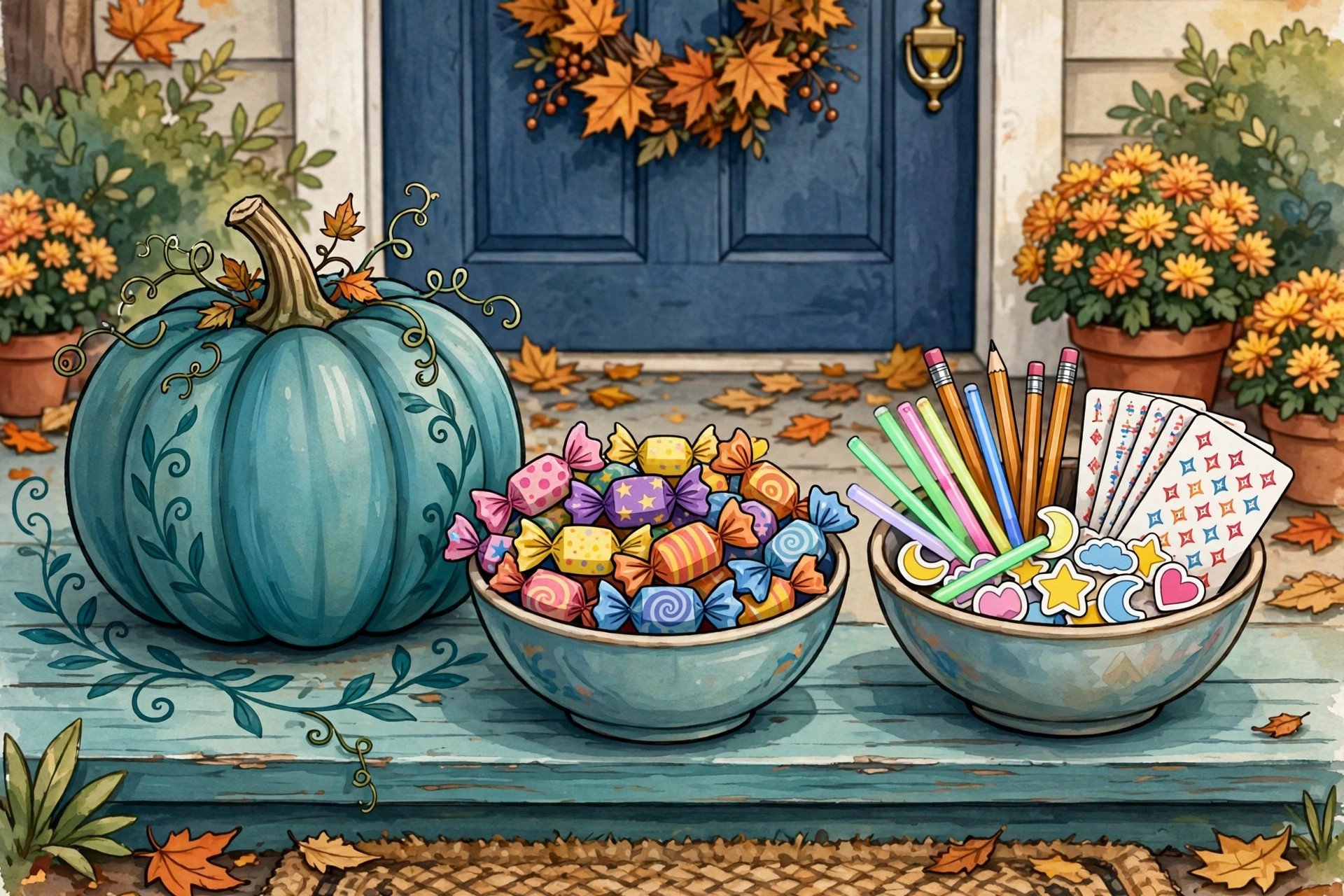
One pumpkin, painted teal, changes what Halloween night feels like for a child who cannot eat most of what lands in a treat bag. It is a signal, readable from the sidewalk: this house has something for you that is not food. With Halloween on Saturday, October 31, 2026, there is still time — eighteen days from October 13 — to set it up properly. Properly is the point of this guide. A teal pumpkin beside a bowl of candy mixed with a few pencils is a gesture. A teal pumpkin beside a genuinely separate, thoughtfully chosen non-food bowl is inclusion.
Please note: this article is general information about a community awareness project, not medical advice and not a guarantee that any item is safe for a specific child. Only a child's caregivers know that child's allergens and restrictions. When in doubt, offer the choice and let the child or the adult with them decide.
What the teal pumpkin means, and the Canadian scale
The Teal Pumpkin Project was officially launched as a national campaign in the United States by Food Allergy Research & Education (FARE) in 2014, and Food Allergy Canada supports the campaign here. The idea stayed deliberately simple as it spread: place a teal-coloured pumpkin in front of your home to show that non-food treats are available for children with food allergies — and for other kids for whom candy is not an option, including children managing conditions such as diabetes or food intolerances. No registry is required, no purchase is required, and the pumpkin can be a real one painted teal, a reusable decorative one, or the project's printed poster in a window.
The Canadian numbers explain why the signal matters on an ordinary street. Food Allergy Canada reports that more than 3 million Canadians self-report at least one food allergy, that over 600,000 Canadian children under 18 have a food allergy, and that 1 in 2 Canadian households are impacted by food allergy in some way. Peanut allergy alone affects about 2 in 100 Canadian children. Health Canada's priority food allergens — peanut, tree nuts, milk, egg, soy, sesame, wheat and triticale, fish, crustaceans and molluscs, and mustard — cover most of what fills a typical Halloween variety pack, because popular candies are often made with dairy, eggs, or nuts or produced in facilities that process them. For a child with a food allergy, avoiding the allergenic food is not a preference; Food Allergy Canada is direct that avoidance is required to prevent a potentially life-threatening reaction. A house that offers a real alternative removes a negotiation that child otherwise has at every single door.
What counts as a non-food treat — and what needs a second look
The classic non-food list is long and inexpensive in spirit: stickers, glow sticks, playing cards, pencils, crayons and markers, bubbles, mini notepads, activity books, stencils, erasers and pencil toppers, bracelets and necklaces, finger puppets, spider rings, vampire fangs, bouncy balls, and whistles. Any of these can be the treat. Two cautions keep the list honest, and both are missing from most teal pumpkin write-ups.
First, non-food does not automatically mean allergen-free. Some toy and craft products can contain latex or gluten — modelling compounds and some novelty items are the usual examples allergy sources flag. A latex-sensitive child handed a rubber ball or a balloon-style toy has traded one problem for another. Read the packaging of non-food treats with the same habit used for candy labels, and keep packaging until the night is over so a caregiver can check it at the door.
Second, keep the bowls genuinely separate. Allergy guidance for hosts is consistent: put non-food items in their own bowl, away from the candy, and let each trick-or-treater choose candy or a prize. A separate bowl is not tidiness — it prevents candy residue, loose wrappers, and handfuls of mixed treats from turning the safe option into a maybe. It also respects the many children who will happily take the non-food treat for reasons that are none of the door-answerer's business.
Choosing treats by age: a comparison
The missing filter in most lists is age. FDA Halloween guidance tells parents of very young children to remove choking hazards — including small toys — from treat bags. A host can apply that same filter before the items ever reach a bag:
| Treat type | Best for | Second look |
|---|---|---|
| Stickers, temporary-style transfers, activity sheets | All ages, including toddlers | Flat, soft, and nothing to swallow; check craft materials if a latex or gluten sensitivity is declared |
| Glow sticks | School-age children; doubles as visibility on a dark street | Follow the product's age label; a cracked stick belongs in the garbage, not in a treat bag |
| Pencils, crayons, mini notepads, playing cards | School-age children | Useful long after October 31; cards and notepads suit older kids who find stickers babyish |
| Bubbles | Younger children, with a caregiver nearby | Small bottles are a spill and a trip hazard on a dark porch step — hand them over, do not toss |
| Bouncy balls, spider rings, vampire fangs, whistles, finger puppets | Older children only | Small parts are exactly what FDA guidance tells parents to pull from a young child's bag; keep these in the older-kid section of the bowl or skip them in a toddler-heavy neighbourhood |
The decision framework is neighbourhood arithmetic. A street of kindergarten-and-under costumes needs the first two rows and little else. A street of ten-year-olds will empty the playing cards and glow sticks first. Buying for the street that actually shows up — the same street-count thinking used for candy budgeting — beats a bulk bag of assorted small toys that is half-unsuitable for half the visitors.
The setup procedure, step by step
- Get the signal ready. Paint a pumpkin teal and let it dry fully, or print the free Teal Pumpkin poster — Food Allergy Canada offers versions reading “Non-food Treats Available Here” and “We Have Candy and Non-food Treats.” Place it where it is visible from the sidewalk, lit if the porch is dark.
- Choose treats by age first, theme second. Use the table above against the ages on your street. Read packaging for latex or gluten content and for age labels, and keep the packaging.
- Set up two bowls, physically apart. Candy in one, non-food treats in another, far enough apart that hands and wrappers do not cross over. Wash hands and the bowls before filling them.
- Add the house to the map. The project maintains a Teal Pumpkin Project Map so families can plan routes around participating homes; listing the address is the step that turns a porch signal into a planned stop.
- Offer the choice at the door, neutrally. A simple “candy or a prize?” to every child — not only to children who declare an allergy — keeps the non-food bowl from feeling like a special-needs bowl.
- Tell the street. Food Allergy Canada's own participation list includes telling family and friends and asking them to join. Two or three teal pumpkins on one street make a route worth planning for an allergy family.
If your household is the allergy household
The same project reads differently from the other side of the door. Families managing a food allergy already know their own rules; the Halloween-specific ones in the sources are worth restating plainly. Check every label, including on familiar candy, because ingredients and manufacturing processes change. Do not eat anything that is not commercially wrapped, and inspect wrapped treats before eating. Carry the epinephrine auto-injector prescribed to the child — Food Allergy Canada identifies epinephrine as the first-line treatment for anaphylaxis, a serious allergic reaction that is rapid in onset and may cause death — and seek emergency care after it is used. Planning a route around the teal pumpkin map, and agreeing the swap-out plan for unsafe candy before the night starts, keeps those rules from becoming arguments on the sidewalk.
FAQ
Does a teal pumpkin mean a house has no candy? No. It means non-food treats are available. Many participating houses run two bowls — candy and non-food — and the poster version for exactly that setup exists.
Does the pumpkin have to be a real pumpkin? No. A painted real pumpkin, a reusable teal pumpkin, or the printed poster all carry the same signal. Visibility from the street matters more than the material.
Are non-food treats automatically safe for every child? No — and this guide is general information, not a safety guarantee. Some products contain latex or gluten, and small items are choking hazards for very young children. Caregivers make the final call for their child, which is why keeping packaging and offering a choice matters.
What if only a few children choose the non-food bowl? That is the expected math, not a failure. On a typical street the bowl serves a small number of children for whom it is the difference between participating and watching — and leftover stickers and pencils keep indefinitely for next year.
Keep readingNext: Halloween makeup safety for sensitive skin →