
Trick-or-treat safety guide for Canadian families (2026)
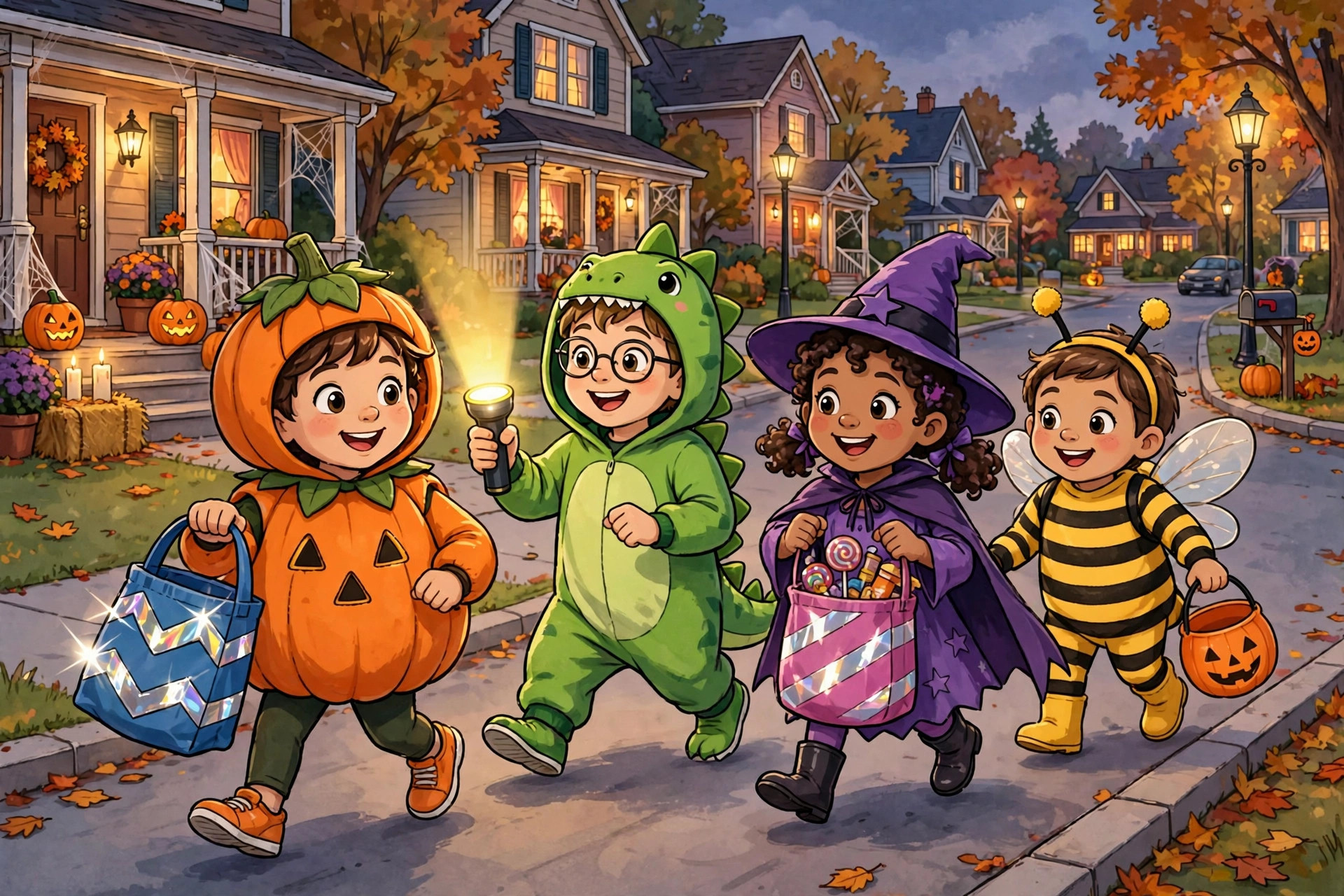
Halloween night concentrates everything that worries a parent into about three hours: dark streets, excited children, and traffic. Manitoba Public Insurance recorded eight pedestrian collisions on October 31 over the past four years — serious enough that the province put 86,580 flashing safety lights into elementary schools in 2025. Most Halloween pedestrian injuries happen between 6:00 and 9:00 p.m., when it's fully dark. Nearly all of it is preventable with visibility, age-matched supervision, and a planned route.
The visibility comparison
Two kinds of visibility fix it — passive (reflects headlights) and active (emits light) — and they work best combined. Prices below are 2025 Canadian retail figures:
| Option | Type | Cost (2025) | Notes |
|---|---|---|---|
| Reflective tape strips | Passive | $8–12 | On costume, treat bag, and shoes |
| Reflective vest over costume | Passive | $10–15 | Maximum reflectivity; fits over winter layers |
| LED glow sticks (24-pack) | Active | $10 | Cheap enough for the whole group |
| LED bracelets/necklaces | Active | $5–10 | Last 8–12 hours — plenty for one evening |
| Kid flashlight | Active | $5–10 | Helps them see obstacles too |
| LED headlamp | Active | $15–25 | Hands-free — best single option for younger kids |
| MPI-style clip-on light | Active | Free (school programs) | Check if your school took part in the 2025 program |
The minimum kit — tape, a few glow sticks, and a small flashlight — runs about $23. Put the tape on before the costume goes on, and don't forget the treat bag: a reflective strip on the bag is visible from behind, the direction traffic sees.
The age-by-age supervision framework
Canadian injury prevention specialists note that many children don't have the skills to cross roads safely until ages 9–11 — so supervision should step down gradually. The Canadian Paediatric Society's age bands:
| Ages | Supervision | Route |
|---|---|---|
| 0–4 | Direct — hand-holding, parent to each door | Very short, 30–60 minutes; consider going before full dark |
| 5–8 | Close — parent walks with the group, waits at the driveway | 60–90 minutes maximum |
| 9–11 | Indirect — small group of 3–5, parent checks in | Planned route in a familiar neighbourhood; charged phone; home by 8:00–8:30 |
| 12+ | Group independence | Group of 4–6, location sharing on, check-ins every 30–60 minutes; home by 8:30–9:00 |
The step most parents skip is the explicit return time. Set it before anyone leaves, and make sure every child knows what to do if separated from the group. The Canadian Red Cross also suggests noting where the Block Parent houses are on your route as safe fallback spots.
Route planning that keeps kids off the road
Most trick-or-treat injuries involve traffic, so treat the route as a safety device:
- Map one side of the street first. Plan the route so kids visit every house on one side before crossing once to the other side — no criss-crossing mid-block, ever.
- Pick the crossing points in advance. Cross only at intersections or crosswalks, never between parked cars. If the neighbourhood has no sidewalks, the rule is walk facing traffic on the left-hand edge.
- Choose porch-light houses only. A lit porch means the household is expecting trick-or-treaters — and a lit walkway means fewer trip hazards. Teach kids to skip dark houses without being told each time.
- Set the curfew and the check-in rule. Agree the return time before leaving (see the table above), and for older kids, the check-in interval. A watch works where a phone would be a distraction.
Costume safety beyond the checklist
The Canadian Red Cross and the RCMP agree on the big three: bright and reflective beats dark every time; face paint beats masks, because masks restrict vision and movement (patch-test for sensitivities first); and short beats long — flowing fabric is a tripping hazard and, with cords or sashes, a strangulation risk. Two Canadian-specific notes: design the costume to work over winter clothing — Toronto Halloweens typically run 5–10°C, and a costume that can't fit over a coat gets abandoned by 7 p.m. — and keep everything away from open flames. LED tea lights (about $10 for a 24-pack) remove the jack-o'-lantern candle risk entirely.
Candy check and allergy planning
When the night's over, the candy gets inspected before anyone eats a piece: packaging intact, nothing opened, nothing homemade from unfamiliar houses. The RCMP adds a Canadian caution: after a 2022 incident of a child ingesting an edible cannabis product, check for THC/cannabis labelling and discard anything suspicious. Small, hard candies are a choking hazard for younger kids; set those aside.
For allergies, Food Allergy Canada's guidance is practical: carry the epi-pen and make sure others in the group know where it is, hold off on eating anything until labels are read at home, and tell neighbours ahead of time. Households can help with non-food treats — stickers and pencils work — and a teal lightbulb on the porch signals an allergy-aware house.
FAQ
What's the single most effective safety purchase? Reflective tape at $8–12 — the cheapest option in the table, and it works with headlights, which is what drivers use to see your child.
Can my 10-year-old go with friends? At 9–11, indirect supervision is the guideline: a small group, a planned familiar route, a charged phone, and a firm return time. Under 9, an adult or responsible older child should be present for every street crossing.
Should I worry about tampered candy? Reports of tampering are rare, but the inspection habit is cheap: check every wrapper, discard opened or suspicious items, and watch for cannabis labelling.
Keep readingNext: pet costumes & safety ground rules →