
Family and group matching costumes: planning on a budget
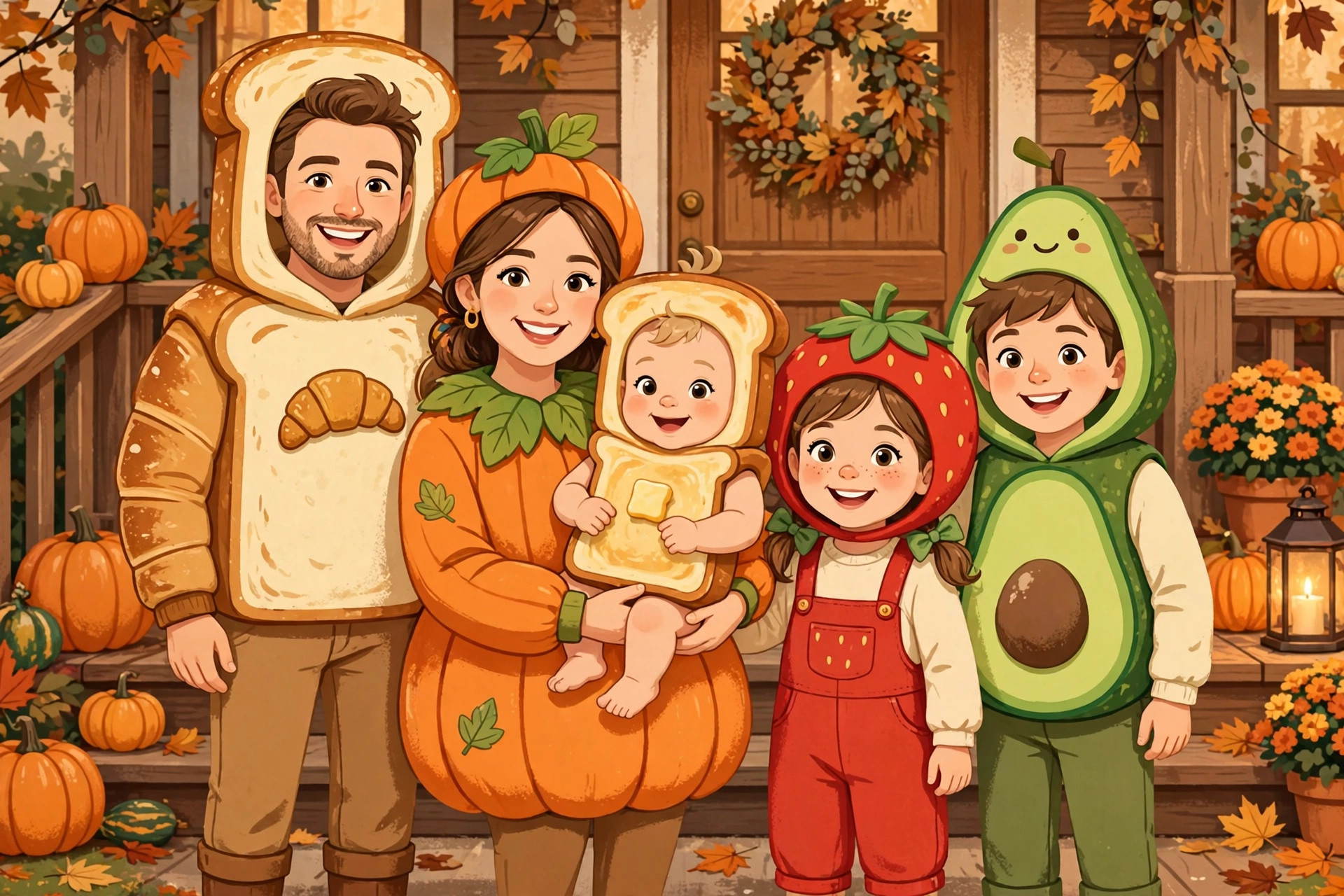
A matching family costume fails in predictable ways, and money is only the second most common one. The first is planning by enthusiasm: one person picks a theme in September, everyone nods, and by the last week of October half the group has nothing to wear. The fix is to run the costume like a small project. Choose the production approach before the theme, total the real cost for your actual group size, assign each person a role matched to how much costume they will honestly wear, and work to one shared timeline. Do those four things and the theme itself becomes the easy part — almost any theme can stretch or shrink to fit a group once the logistics are honest.
Pick the approach first: DIY, hybrid, or ready-made
Three approaches cover nearly every family plan. The published per-person ranges below come from a 2026 family-costume planning guide (which does not state a currency, so treat the figures as planning ranges, not shelf prices) — what matters is the shape of the trade-off: DIY trades hours for dollars, ready-made trades dollars for hours, and the hybrid splits the difference.
| Approach | Cost per person (as published) | Time per person | Best for |
|---|---|---|---|
| DIY from closet and craft supplies | About $15–40 | 10–15 hours total project work | Craft-confident groups; themes built on clothing plus one made piece |
| Hybrid: coordinated tees plus DIY accessories | About $20–35 | An evening or two | Mixed-commitment groups; one purchase decision coordinates everyone |
| Ready-made | About $25–75 | Minimal — fitting only | Late starts, exact character looks, groups with no craft capacity |
The DIY end can go lower than the published range when the theme is built on clothing the family already owns. One sibling-costume guide builds a salt-and- pepper pair from basic clothing plus handmade paper labels for under $15 total, and superhero looks from felt masks and metallic accessories sourced at dollar stores. The lesson is not the specific number — it is that DIY cost is driven by how much of the costume is a base layer you already own. Solid-coloured clothing is the hardest-working base: the same black or white basics anchor several different character combinations across siblings and across years.
What it actually totals: family-of-four and family-of-five math
Per-person ranges hide the decision. Multiply them out before anyone commits, using the same published ranges:
| Group | DIY total | Hybrid total | Ready-made total |
|---|---|---|---|
| Family of 4 | $60–160 | $80–140 | $100–300 |
| Family of 5 | $75–200 | $100–175 | $125–375 |
| Group of 6 friends | $90–240 | $120–210 | $150–450 |
Read the table with the time column from the comparison above. A family of five going full DIY is signing up for a project measured in evenings across several weeks, not one craft afternoon — the guide behind these ranges puts DIY at 10 to 15 hours of work. That is exactly why the mixed approach wins for most real families: ready-made or hybrid for the members with no time, DIY effort concentrated on one or two hero pieces (the baby, the family dog's photo-op partner, the parent who loves this) where the handmade work actually shows. Budget the accessories line separately, too: hats, face paint and props are where matching sets quietly overspend, because each person's add-ons get bought one at a time with no running total.
Assign roles by commitment, not by enthusiasm
Every group has the same cast behind the cast: someone who wants the full build, someone who will wear a shirt, a baby who needs comfort and diaper access, and someone whose budget is tighter than the rest. Assign for the group you have:
| Member | Role design | Why it works |
|---|---|---|
| The enthusiast | The most detailed character; carries the theme's signature prop | Their effort sets the photo's focal point and covers for simpler looks around them |
| The willing but busy | Coordinated tee or one strong accessory (hat, cape, face paint) | Visual connection in photos without a build; this is the hybrid approach worn by one person |
| The reluctant | Matching accessory, themed colours, or a coordinated Halloween t-shirt only | Participation stays voluntary, which is what keeps them in the photo at all |
| The baby | The theme's smallest character in soft fabrics with snap closures for diaper access | Food themes shine here — the baby as the toast in a breakfast set, or the smallest berry in a fruit basket |
| Anyone on a tighter budget | A closet-built character within the same theme; the group kit (felt, paint, cardboard) is bought once and shared | The theme absorbs different spend levels because cohesion comes from palette and accessories, not identical purchases |
The shared-kit point deserves emphasis for groups of friends splitting costs: choose the theme first, then assign each person a character based on preferences and the clothing they already have, and build from shared materials — old t-shirts, cardboard, felt and fabric scraps go further when one person buys for the group instead of six people buying overlapping supplies.
The coordination timeline that prevents the October scramble
Published timelines disagree because they assume different approaches — reconciled, they form one schedule. For ready-made costumes, guides advise starting 6 to 8 weeks before Halloween to leave room for shipping and exchanges; DIY and print-on-demand need 8 to 10 weeks for production, shipping and alterations. Group-costume guides land in the same place from the other side: start planning 4 to 6 weeks out at the latest — for 2026, early October — with thrift hunting at its best 3 to 4 weeks before Halloween, before the racks are picked over. The working version:
- Late August to early September: pick the approach and the theme; assign roles using the framework above; set the per-person budget cap out loud.
- September: order anything ready-made or printed; split the thrift hunt — assign each person a colour or era to search for, share finds with photos in a group chat, and confirm sizes before anyone buys.
- Early October: build the DIY pieces in one or two group sessions; do a full fitting — check comfort, vision and movement for every member, especially kids.
- The week before: lay out every costume complete, photograph the full group once if you can, and repair or replace the one piece that is always missing.
Themes that stretch to fit any group size
The safest themes have more characters than your group has people. Franchises and story sets with five or more distinct characters absorb a family of five and still have a role left for a grandparent or a friend. Food sets scale in both directions — a breakfast crew works as two (milk and cookies) or as seven (add toast, egg, bacon, coffee and juice) — and they are forgiving builds: basic clothing plus one foam or felt shape per person. Closet-first classics like a garden gnome family (red felt hats, beards, plaid shirts, much of it already at home) suit toddlers and tight budgets. Whatever the theme, carry the safety rules across: attach young children's capes with a breakaway clasp rather than a tied cord, hem capes to clear the floor, paint beards on the youngest kids with skin-safe face paint instead of attaching a fuzzy one, sew felt pieces on securely rather than gluing where a toddler can pull them loose, add battery-operated lights for evening visibility, and choose washable materials so the set survives to be reused or handed down.
FAQ
What if one person refuses to dress up at all? Do not spend October negotiating. Offer the accessories-only role — a themed colour, one prop, or the group photographer job, which is a real role at a family event. A group photo with one person in a matching-coloured sweater still reads as a set; a group photo missing that person entirely does not.
Is DIY actually cheaper once time counts? On dollars alone, usually yes — the published range tops out below ready-made's mid-point. On dollars plus evenings, often no. The honest test is whether the building is part of the fun for your group. If it is not, the hybrid approach buys most of the matching look for an evening or two of work.
How do friends split costs fairly? Cap the per-person spend in advance, buy shared materials once from a pooled amount, and let members individually choose ready-made upgrades above the cap. Fairness comes from the cap being agreed before anyone shops, not from everyone spending the same.
Keep readingNext: 2026 costume trend themes →